Advertising 1

This advertisement reflects a gender stereotype. Downy is a brand name of fabric softener produced by Procter & Gamble in the United States. To explain this advertisement, there are two girls, one of whom is dressed in disheveled attire with an unpleasant look on her face, and the other is dressed in neat attire with a satisfied look. It says, “Guess whose mother used Downy? You guessed.”, and “It is static cling season. Shouldn’t you use Downy?” (Krutt, 2018).
This shows a gender stereotype that fabric softener is for the mother, because doing the laundry is the exclusive property of women. This seems to be an advertisement made in the days when most of the housework was done by women. These days, most families work double-income, so the housework is shared by the couple. Therefore, the general stereotype that the doing the laundry belongs to the woman is far from true.
Advertising 2

This advertisement counters a gender stereotype. This is a non-smoking public service advertisement produced by South Korea’s Ministry of Health and Welfare and the National Smoking Support Center. To explain this advertisement, a woman is trying to smoke from her cigarette case without a particular look. In the picture of the pack of cigarette, a woman clutches her neck and is distressed.
It says, “Please, give me a larynx cancer.”, and “Smoking is a disease. Treatment is to stop smoking.” (Design Press, 2017). While many cigarette-related ads used to model men in the past, this advertisement used women as models against gender stereotypes that cigarettes were only the man’s possession. Since there are many female smokers these days, the gender stereotype that cigarettes are for men is wrong.
Advertising 3

This advertisement fails to reflect a gender stereotype. General Electric Company is an American multinational conglomerate. To explain this advertisement, an elderly couple on the left stands contentedly behind a gas oven, and a young couple on the right stands affectionately behind a gas oven with smile. It says, “Presenting the best way to clean up the worst job in the kitchen.” (Pinterest, 2019).
This fails to reflect a gender stereotype that cooking utensils are for the women. It focused on the functioning of a gas oven and emphasized that gas ovens are home appliances, using both men and women as advertising models. Nowadays, most of the chefs in TV cooking programs are men, and many men are cooking at home. Therefore, this method of advertising without the gender stereotype is very appropriate.
Advertising 4

This advertisement reflects a gender stereotype. Hyundai Motor Company is a car production and sales company affiliated with Hyundai. To explain this advertisement, On the upper part, a woman is sitting in the driver’s seat looking at the camera and saying “For people who are sensual but do not have a good sense of driving like me.” On the lower part, a man is sitting in the driver’s seat looking at the camera and saying, “For people who drive everyday like me.” (Dispatch, 2017).
This shows a gender stereotype that the man drives daily and the woman is not good at driving. Many modern women continue to work after marriage, have a car, drive daily, and are good at driving, and many men are not good at driving. This is a very wrong gender stereotype, because it depends on how much driving experience the person has or the personality of the person, not on the gender.
Advertising 5
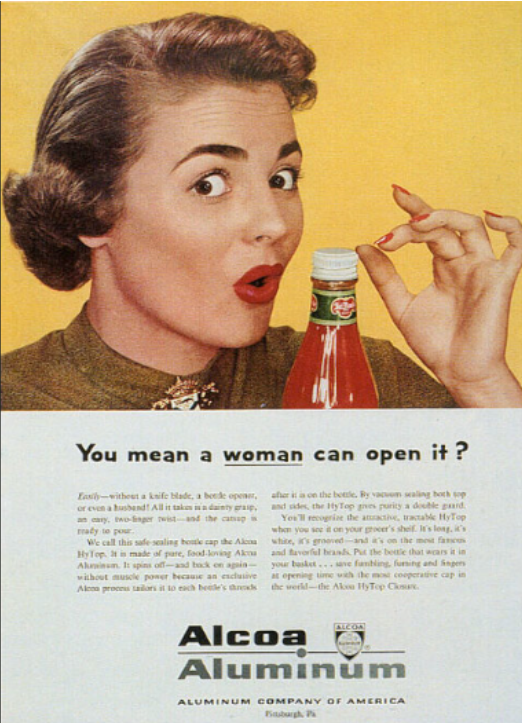
This advertisement reflects a gender stereotype. Alcoa Corporation is an American industrial corporation, and this advertises Alcoa aluminum. To explain this advertisement, a woman looks surprised and tries to touch the lid of the bottle, and underneath it says, “You mean a woman can open it?” (Express, 2017). This shows a gender stereotype that women are so weak that they are described as unable even to do minor things like opening a bottle cap without the help of men.
It is true that women are weaker than men, but the wording of the advertisement is so exaggerated that it seems to mock women. Women have the ability to do many things on their own, and the women and men have their own strengths and weaknesses. They are born differently to fill in the gaps of their opponents, so one should not discount the other’s shortcomings.
References
- Design Press. (2017, February 22). The fall of tobacco in image. Retrieved from July 8, 2019 from https://m.blog.naver.com/designpress2016/220942022142
- Dispatch. (2017, May 24). Gender stereotype in the advertisement: Car advertisement. Retrieved from July 8, 2019 from https://www.dispatch.co.kr/755168
- Express. (2017, July 19). Gender stereotypes in advertising banned – Look back at when adverts were really sexist. Retrieved from July 8, 2019 from https://www.express.co.uk/life-style/life/830397/Gender-stereotypes-in-advertising-gender-role-adverts-ads-sexism
- Krutt, H. (2018, March 1). Then and now: The evolution of gender stereotypes in advertising and how far we’ve yet to travel. Retrieved from July 8, 2019 from https://landt.co/2018/03/the-evolution-of-gender-stereotypes-in-advertising/
- Pinterest. (2019). Vintage general electric self-cleaning oven print magazine ad 1979 GE original. Retrieved from July 8, 2019 from https://www.pinterest.co.kr/pin/414401603193150074/
 Gender Stereotypes